Far South Halsted Corridor Study prepares for future Pace Pulse service
February 19, 2025
February 19, 2025
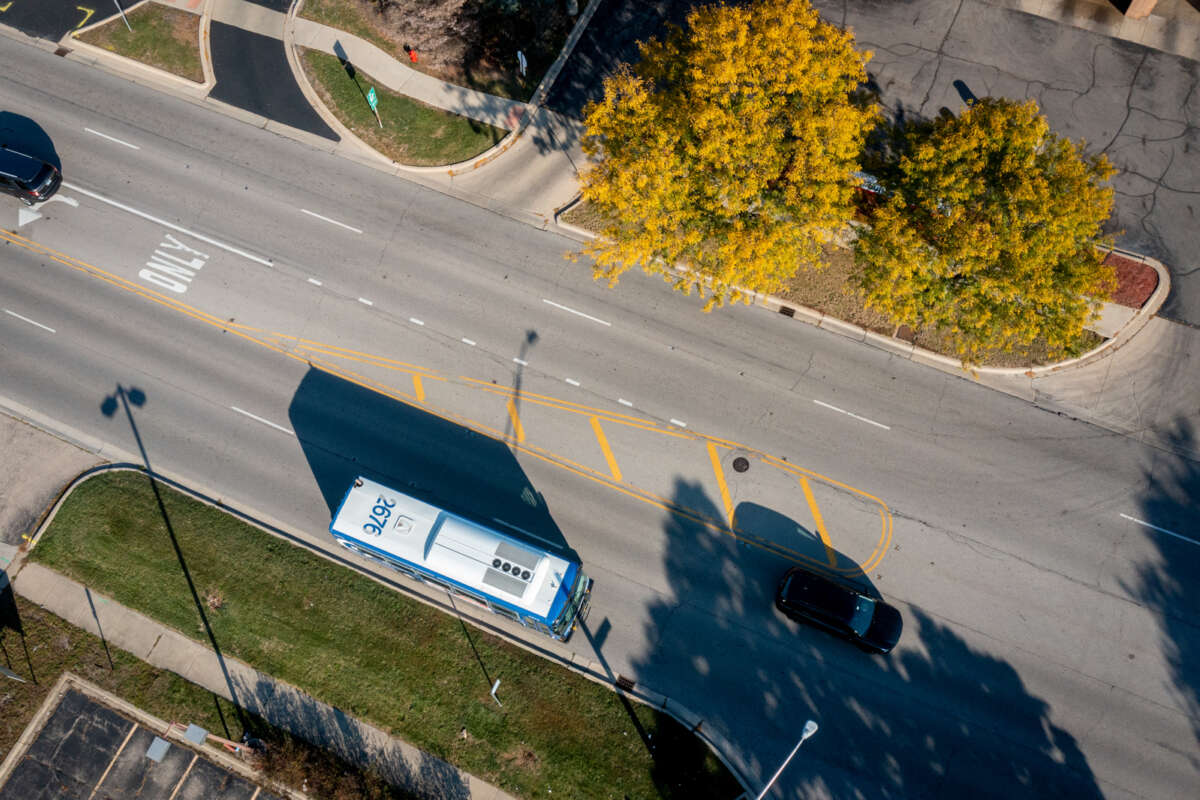
An RTA Community Planning project kicked off in late 2023 as a crucial step in bringing Pace Pulse service to Chicago’s south suburbs. The Far South Halsted Corridor Study seeks to increase transportation resilience, encourage transit-oriented development (TOD), improve walkability and bicycle access, and develop strategies that prepare the corridor to support improved bus service between the Harvey Transportation Center and the Chicago Heights Transportation Center. Click here to answer a brief survey on land use, transportation, bicycle, and pedestrian improvements in the corridor. Haga clic aquí para responder una breve encuesta sobre uso del suelo, transporte, mejoras para bicicletas y peatones en el corredor.
Since the project began, the RTA and Pace have collaborated with a consultant team to examine current infrastructure, identify opportunity sites for redevelopment, and determine potential station locations for Pace Pulse service in the corridor. In preparation for drafting the study's final report, RTA and Pace invites the public to share feedback on these findings at a public meeting on March 4 at Prairie State College. The meeting takes place from 4-6 p.m. in the Prairie State College Conference Center, Proven IT Room, at 202 S. Halsted St., Chicago Heights, Parking Lot D, enter through doors M36. Exhibits will be on display and project team members will be present to discuss the project and answer questions.
The RTA’s Community Planning program provides funding and technical assistance to local governments to help foster the growth of sustainable, equitable, walkable, and transit-friendly communities. Since 1998, RTA has completed more than 200 projects.
Pulse is Pace’s bus rapid transit service. It offers a variety of benefits compared to regular fixed-route bus service, including faster travel times with limited stops and transit signal priority, free Wi-Fi and other amenities, modern stations with heated shelters and real-time bus arrival information, faster boarding, and improved ADA accessibility with raised bus platforms at all stations. In 2019, Pace launched the Pulse Milwaukee Line, serving thousands of commuters between Niles and Chicago. This summer, Pace launched the Pulse Dempster Line between Evanston and O’Hare Airport. The Pulse Halsted Line, scheduled to launch in 2027, will serve Pace’s highest-ridership corridor from 95th Street south to Harvey.
To prepare for an expansion of the Pulse Halsted Line from Harvey south to Chicago Heights, the RTA and Pace have initiated the Far South Halsted Corridor Study, which will focus on initial planning for future Pulse service. Although they are closely related, the Far South Halsted Corridor Study and the Pulse Halsted Line cover different geographic areas, with the Far South Halsted Corridor Study focusing exclusively on the portions of Halsted between Harvey and Chicago Heights. In conjunction with a new Transportation Center at the Harvey Metra Electric station, the Pulse Halsted Line, and the Pulse 95th Street Line, this corridor study represents significant investment by Pace to improve transportation in South Cook County.
The Far South Halsted Corridor Study builds off Pace’s previously completed plans and studies for this area, including the Pace Pulse Corridor Development Plan and the Harvey TOD Plan. The project aligns with RTA’s regional transit strategic plan, Transit is the Answer, which calls on the agency to support communities’ efforts to improve the area around their transit stations and stops and pursue equitable transit-oriented development, as well as to partner with roadway agencies to build more transit-friendly streets and advance bus rapid transit.
One of the project team’s first tasks was to investigate the existing conditions within the study area to understand how IL Route 1/Halsted’s roadway infrastructure should accommodate Pace Pulse service. A sidewalk and bicycle infrastructure inventory will also be included in the plan, as well as a crash analysis, transit analysis, and market analysis. The market analysis will make recommendations for the type of development opportunities in the residential, commercial, light industrial, and hotel and entertainment markets that are feasible along the corridor.
The development of the study is guided by a steering committee made up of individuals from the following organizations and municipalities: Chicago Heights, East Hazel Crest, Glenwood, Harvey, Homewood, South Holland, Bloom Township, Prairie State College, RTA, Pace, Metra, the Chicago Metropolitan Agency for Planning, the Illinois Department of Transportation, Illinois Tollway, Cook County, South Suburban Mayors and Managers Association, Chicago Southland Chamber of Commerce, and Wind Creek Casino. Community engagement around the study will be guided by three core principles: inclusion, transparency, and collaboration. The approach is focused on building trust and creating a sense of ownership in the communities within the study area. In addition to the public meeting on March 4, there will be several pop-up meetings throughout the corridor to meet community members where they are. Stakeholders will be compensated for their time providing feedback and input, dependent upon their level of participation.
Learn more about the RTA’s Community Planning program.
Subscribe to our Newsletter
Related Articles
 Northern Illinois Transit Authority Begins New Era for Regional Transit
New regional transit authority unifies CTA, Metra and Pace around shared vision for safer, more reliable and better-connected transitThe Northern Illinois Tr...
September 1, 2026 Study lays groundwork for more coordinated regional transit service under NITA
A new regional transit service coordination study will help bridge between current service planning practices and the first Northern Illinois Transit Authori...
August 3, 2026 RTA announces largest Access to Transit program, bringing $11 million of bicycle and pedestrian improvements to stations throughout region
The RTA has selected 21 new projects at a total cost of $10.9 million for its Access to Transit program, making it the largest round of funding in agency his...
June 24, 2026 Recently completed Community Planning projects to improve mobility in Bronzeville, Sauk Village
This spring, two projects wrapped up that will make communities throughout the Chicago region more equitable, accessible, and transit-friendly, thanks to sup...
June 11, 2026 How the NITA trailer bill and 2027 state budget will impact Chicagoland transit
On May 31, 2026, the eve of the Northern Illinois Transit Authority (NITA) Act (Public Act 104-457) taking effect, the Illinois General Assembly passed trail...
June 11, 2026 RTA adopts Human Services Transportation Plan (HSTP) to improve transportation access for all
At their May meeting, the RTA Board of Directors adopted the 2026 Human Services Transportation Plan (HSTP), a federally required document that identifies tr...
June 1, 2026