Save Transit Now stories: Hear from residents urging lawmakers to fund the regional transit system
October 22, 2025
October 22, 2025
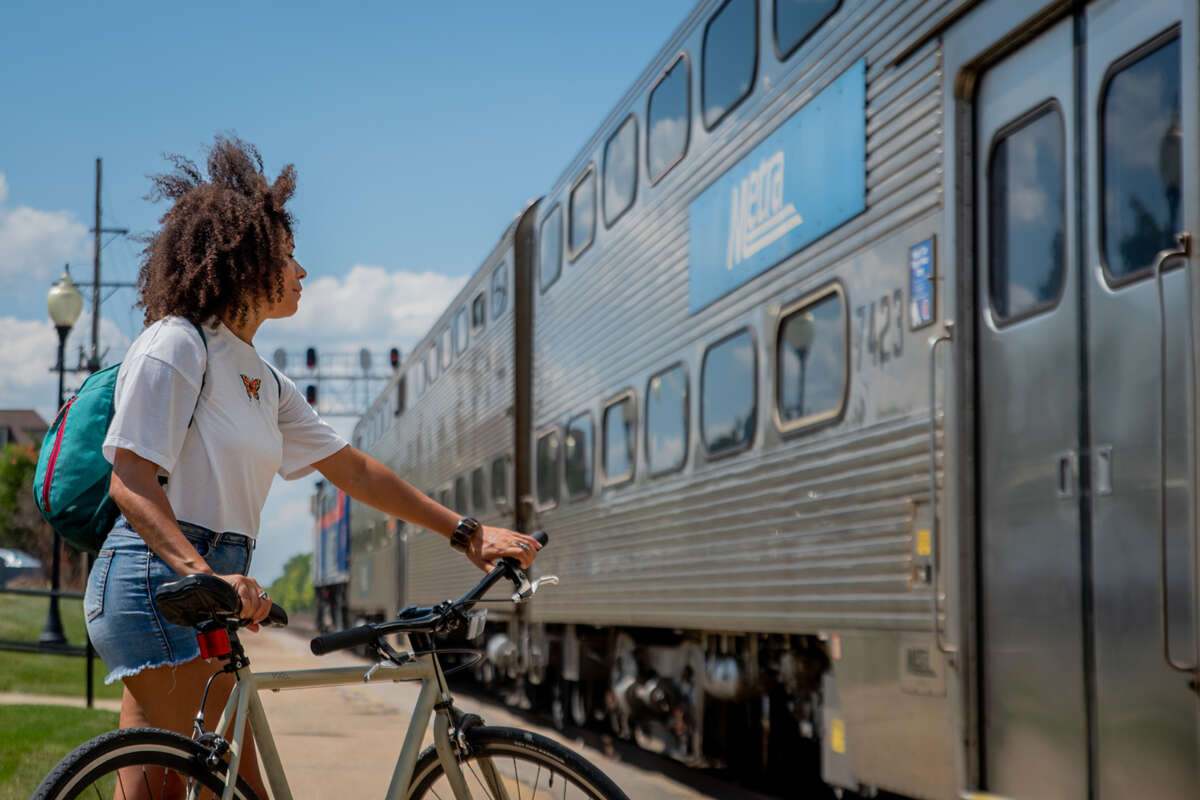
This year, more than 20,000 letters have been sent to Illinois legislators through RTA’s Save Transit Now campaign, urging them to pass sustainable transit funding and reform. Our region faces a fiscal cliff starting in 2026 that will lead to devastating service cuts and reduced access to jobs, education, and medical care if not addressed. We are advocating for a $1.5 billion annual investment backed by an empowered regional entity that can help transit not only survive but thrive.
Thousands of riders across the region have joined this call for improved transit —sharing personal stories about how public transit impacts their lives, their families, their communities, and their futures. The RTA has been highlighting some of these rider stories below and on our social media channels as legislators continue to work toward a solution before the end of the General Assembly Fall Veto Session on October 30.
We urge all residents and riders to share their story today at www.SaveTransitNow.org.
Karl Gieseke of Oswego takes Metra and CTA to work in the Illinois Medical District three days a week. A veteran himself, his work supports providing healthcare to veterans, who he sees firsthand rely on public transportation to access care. Gieseke argues that not only would service cuts be devastating to this community, but investment to provide service above and beyond current levels is desperately needed.
“Often providers will come in and say, ‘You're scheduled for an appointment to see your doctor, why didn't you make it?’ And often the answer was, ‘I didn't have a way there,’” Gieseke said. “‘My daughter, my son, my caregiver couldn't take the day off work. My spouse was using the car that day. I just didn't have a way to get there.’ And I think that really speaks to the need for robust transit systems in and around healthcare facilities and other places that people receive the care they need.”
Thousands of residents with disabilities in the Chicago region can hold jobs, run errands, connect with friends and family, and access healthcare despite being unable to drive—thanks to the regional transit system. Without it, many would be trapped at home, dependent on others for rides, and unable to enjoy independence and contribute to their communities.
Stephanie DeCarlo of Kankakee teaches over 200 students with disabilities in the south suburbs to use public transportation. Her students are ages 18-22 and can experience a wide variety of physical, developmental, or cognitive disabilities.
“By having a cost-effective means for people to be contributing members and being able to actively participate in their lives, you’re only improving your communities,” DeCarlo said.
Deborah Lints of Aurora has a son with autism who rides Pace Paratransit to his job twice a week and has for the past 12 years. He works in the HR department of a local school district, and like anyone else, he needs to arrive on time. While he’s unable to drive, he loves his job and wouldn’t want to lose it just because he has no way to get there.
“We don’t want him to lose his job,” Lints said. “It’s something he has pride in that he can do. Anybody who is disabled in any way that cannot drive but can work or needs to go to a medical appointment, we need to help them get there.”
Lesley Skousen lives on the South Side of Chicago and teaches public policy and history. She always encourages her students to be engaged in the political process, so she felt compelled to write her legislators urging them to fund public transportation. The issue is personal for Skousen, as she has epilepsy and relies on the transit system to get herself and her 3-year-old daughter everywhere they need to go.
As someone with epilepsy, Skousen was ineligible to get her driver’s license until the age of 26. She moved to Chicago as a teenager because it is one of the few cities in the United States with a transit system that would empower her to be independent and access education, jobs, healthcare, etc. While she did drive for a time after turning 26, she sold her car a decade ago because she realized the Chicago transit system was a far less expensive, reliable transportation option. The money saving has allowed her to adopt a child and put her in childcare.
“As a parent, access to good transit is the backbone of my entire life,” she said. “The CTA and a bike trailer are enough to get us around the entire city. I want my daughter to be empowered to explore her city and the suburbs. Already she’s familiar with the bus and train lines at just 3 years old. I don’t take her—she can take me to our local station, get on the right train, go in the right direction, and tell me when it’s time to get off. She also likes to ‘ding’ on the bus and say hi to the bus driver.”
Graham Talbot of Chicago’s Humboldt Park neighborhood rides CTA and Metra multiple times a week to explore other neighborhoods and attend large events downtown. He feels quality public transportation is a major pillar of a world-class city, and it’s also part of his family history.
“My great grandma grew up in Cicero and then met my great grandpa while she was still living here before they moved all over the place,” Talbot said. “By being in Chicago, they had so many opportunities to experience the world; the other side of my family lived in rural Kansas, and the contrast is always like, rural Kansas didn't have electricity. It's part of the wonderful part of living in a city: We have access to so many things and people and events and opportunities. Being able to take the L downtown is what my great grandma did and how she enjoyed seeing the world with her friends. And it's the same thing I enjoy doing today. It's a cool legacy to continue.”
Teresa Klier of Evanston rides transit to downtown Chicago for her volunteer gig as a tour guide for the Chicago Architecture Center’s “Elevated Architecture Tour,” which takes attendees around the Loop on the Pink Line. The tour gets off the train at several stops to view and learn about iconic architecture from a unique perspective 20 feet off the ground.
“It's a very unique type of tour and we have guests from all over the world that have taken it; in the summer I had somebody from Singapore, we've had people from Spain, visitors from the East Coast, but we actually get a lot of local people as well,” Klier said. “There's a civic pride that comes from just knowing that the L is down there, even if they never ride it. After getting off of the L, they’re just like, ‘Wow, that's really, really amazing.’”
Chicago’s transit system needs sustainable funding to not only maintain current levels of service but improve the rider experience.
“If I could say one thing to my legislators about saving transit, I would ask them to look at this less as a cost, but more flipping the question and saying, ‘What would the Chicago area be like if we didn't make this investment in transit?’” Klier said. “What would the additional cost be if instead we had to rely on more people driving? The cost is sometimes not all that it seems.”
Subscribe to our Newsletter
Related Articles
 Ad Hoc Committee on the Transition to NITA issues final report
Between the June 1 effective date of the Northern Illinois Transit Authority (NITA) Act and the September seating and first meeting of the new NITA Board of ...
September 18, 2026 Meet NITA’s first Board Chair and Interim Executive Director
At its first meeting on September 10, the NITA Board of Directors selected two leaders who will help guide the new regional transit agency through its next p...
September 10, 2026 Northern Illinois Transit Authority Begins New Era for Regional Transit
New regional transit authority unifies CTA, Metra and Pace around shared vision for safer, more reliable and better-connected transitThe Northern Illinois Tr...
September 1, 2026 Study lays groundwork for more coordinated regional transit service under NITA
A new regional transit service coordination study will help bridge between current service planning practices and the first Northern Illinois Transit Authori...
August 3, 2026 RTA announces largest Access to Transit program, bringing $11 million of bicycle and pedestrian improvements to stations throughout region
The RTA has selected 21 new projects at a total cost of $10.9 million for its Access to Transit program, making it the largest round of funding in agency his...
June 24, 2026 Recently completed Community Planning projects to improve mobility in Bronzeville, Sauk Village
This spring, two projects wrapped up that will make communities throughout the Chicago region more equitable, accessible, and transit-friendly, thanks to sup...
June 11, 2026