Metra envisions regional rail, express service to O’Hare during presentation to RTA Board
August 21, 2024
August 21, 2024
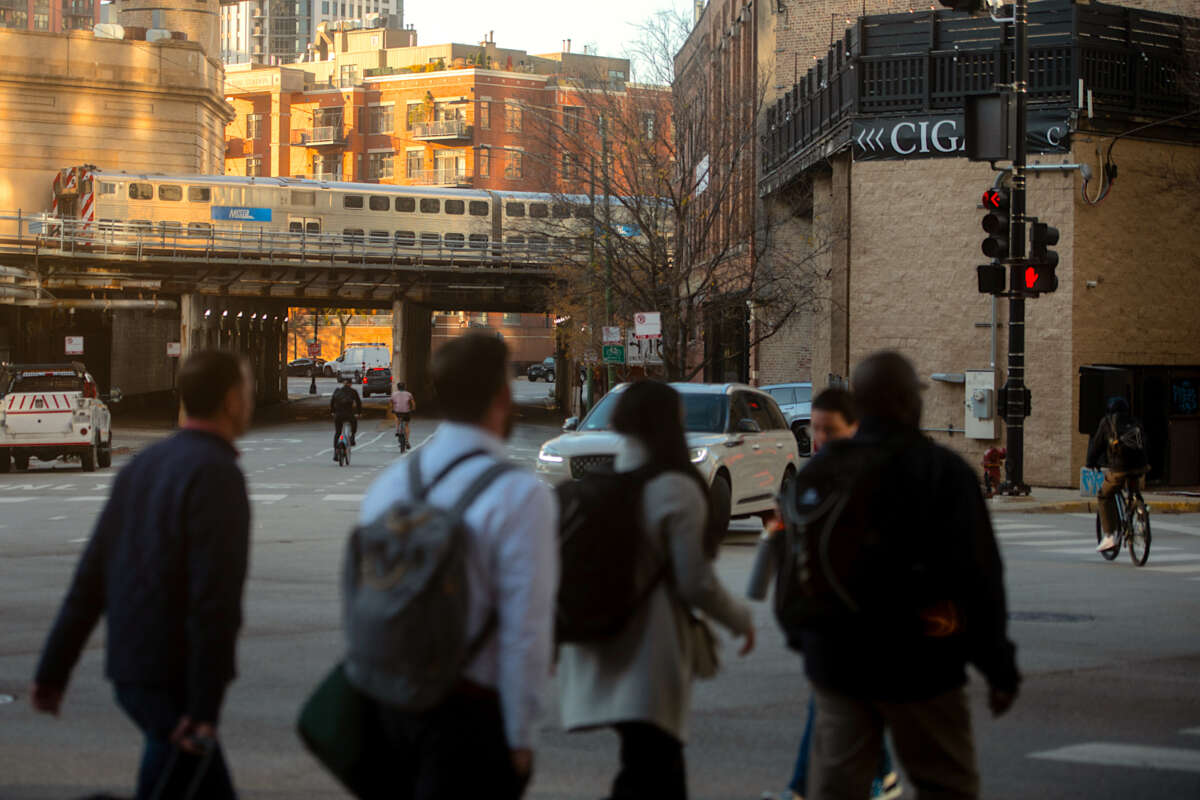
Metra Executive Director Jim Derwinski presented a midyear update to the RTA Board of Directors during their meeting on August 15, outlining improvements the agency has made so far this year as well as a long-term vision for a regional rail network, including express service from O’Hare International Airport to downtown Chicago’s Union Station. Watch the presentation on YouTube.
Coinciding with the Democratic National Convention in Chicago, Metra offered temporary O’Hare express service on the North Central Service line from August 12 to August 30. In partnership with the two freight railroads that control movement on those tracks, service to the airport increased from 7 inbound and 7 outbound trains per weekday to hourly inbound and outbound trains seven days a week.
Derwinski explained what it would take to make this level of service permanent. Because Metra shares these tracks with freight trains, a significant capital investment in flyovers and grade separation at multiple points would be needed to increase capacity on the tracks. One major chokepoint, for example, is the A2 interlocking, a massive rail junction near Grand and Western avenues that was built in 1907 and handles about 350 trains a day. Hourly Metra service outside the pilot program is impossible without a billion-dollar-plus flyover that would allow trains to pass through the area without waiting on other trains.
Metra is currently doing a Systemwide Network Plan to look at what infrastructure improvements would be needed to meet Metra’s regional rail vision. In addition to an A2 flyover, expanded O’Hare service likely would need an expanded yard to store and service the additional trains needed for such a significant service increase. The service would also need agreements with the freight railroads, other infrastructure improvements—and the funding to make it all happen.
O’Hare Express Service fits into a larger vision for Metra to become a true regional rail agency, which was identified in their 2023-27 strategic plan My Metra, Our Future. Regional rail would include service at regular intervals with consistent stopping patterns throughout the day. Service would not just be oriented around bringing commuters to the urban center, but instead would provide all-day transportation options for all trip types throughout the region. A regional rail model would maintain significant service during rush-hour to meet downtown worker travel demand, but less frequent peak service than commuter rail.
To achieve this, funding would be necessary to expand rail yards, build flyovers, add tracks, and increase operations. Currently, because Metra shares tracks with freight trains and Amtrak, the system is at capacity. Infrastructure needs and optimized train schedules for regional rail are being developed in the Systemwide Network Plan. Based on previous work, estimates indicate it could cost $15-20 billion to build and an additional $300-500 million per year to operate regional rail service. While the costs are significant, Derwinski argued it would be a worthwhile investment for the region.
“We’ve got to make decisions here in the State of Illinois, in this country; if we’re going to prioritize public transportation at the highest level, then it’s got to be funded at the correct level, and we’ve all too often not funded things correctly,” he said at the board meeting. “What I love about Metra’s story is we did come from bankrupt properties, where it didn’t make it in the private market. We inherited all this stuff, and I’ve said it before: I think we’ve done too well. We’ve done too much with too little, and we’ve just been compromising. That’s why we’re still running 1953 cars. That’s why a 1977 locomotive probably brought the Chairman in today. The public deserves better than that, Metra riders deserve better than that, and the region deserves better than that.”
Before getting into a bold vision for the future of Metra, Derwinski shared progress and improvements made so far in 2024. Early this year, Metra unveiled a new, simplified fare structure that reduced the number of zones from 10 to four. In the six months since the switch, Monthly Pass sales have increased by 11 percent, and average monthly fare revenue has tracked close to what was budgeted—sometimes exceeding estimates.
Metra also revised its onboard bike policy this year to allow bikes on all trains. This has resulted in a 40 percent year-over-year increase in bikes on trains through June of this year. And bike-related complaints from both cyclists and non-cyclist Metra riders have declined year-over-year.
Also this year, Metra launched the Access Pilot Program with the RTA and Cook County, extending reduced fares to Metra riders experiencing low incomes. So far, 28 percent of Access riders are new to the system, 56 percent are riders who used to pay reduced fares on the Metra Electric and Rock Island lines under the Fair Transit South Cook Pilot, and 16 percent are riders who formerly paid full fare on other lines.
And the Peterson/Ridge Station on the Union Pacific-North line opened May 20, increasing transit access to Edgewater residents.
These efforts have culminated in steady ridership growth, with all of Metra’s top 10 COVID-era ridership days occurring in the June, July, and August of 2024.
Public transit plays an essential role in the lives of millions of riders across the Chicago region and has the potential to reach even more people. But the rise of remote and hybrid work and its staying power post-COVID have resulted in significant losses in fare revenue and exacerbated the issue that most systems nationally have been experiencing for decades: drastic underfunding of public transportation. Increasing investment in transit is key to advancing equity, growing our economy, and combating climate change.
No single revenue source will solve the fiscal cliff on its own. RTA is working with partners and local, state, and federal officials to explore a range of options for new revenue while implementing a strategic plan focused on building a safer, more reliable, and more accessible system. Join the Transit is the Answer Coalition to advocate for sustainable funding for public transportation.
Subscribe to our Newsletter
Related Articles
 NITA launches Rider Advisory Councils, now accepting applications
As NITA builds a unified, rider-focused transit system for the Chicago region, we are inviting riders to help shape that work directly. NITA is now accepting...
September 25, 2026 Ad Hoc Committee on the Transition to NITA issues final report
Between the June 1 effective date of the Northern Illinois Transit Authority (NITA) Act and the September seating and first meeting of the new NITA Board of ...
September 18, 2026 Meet NITA’s first Board Chair and Interim Executive Director
At its first meeting on September 10, the NITA Board of Directors selected two leaders who will help guide the new regional transit agency through its next p...
September 10, 2026 Northern Illinois Transit Authority Begins New Era for Regional Transit
New regional transit authority unifies CTA, Metra and Pace around shared vision for safer, more reliable and better-connected transitThe Northern Illinois Tr...
September 1, 2026 Study lays groundwork for more coordinated regional transit service under NITA
A new regional transit service coordination study will help bridge between current service planning practices and the first Northern Illinois Transit Authori...
August 3, 2026 RTA announces largest Access to Transit program, bringing $11 million of bicycle and pedestrian improvements to stations throughout region
The RTA has selected 21 new projects at a total cost of $10.9 million for its Access to Transit program, making it the largest round of funding in agency his...
June 24, 2026