Transportation Tuesday webinar explores centering the transit-dependent in TOD
June 10, 2022
June 10, 2022
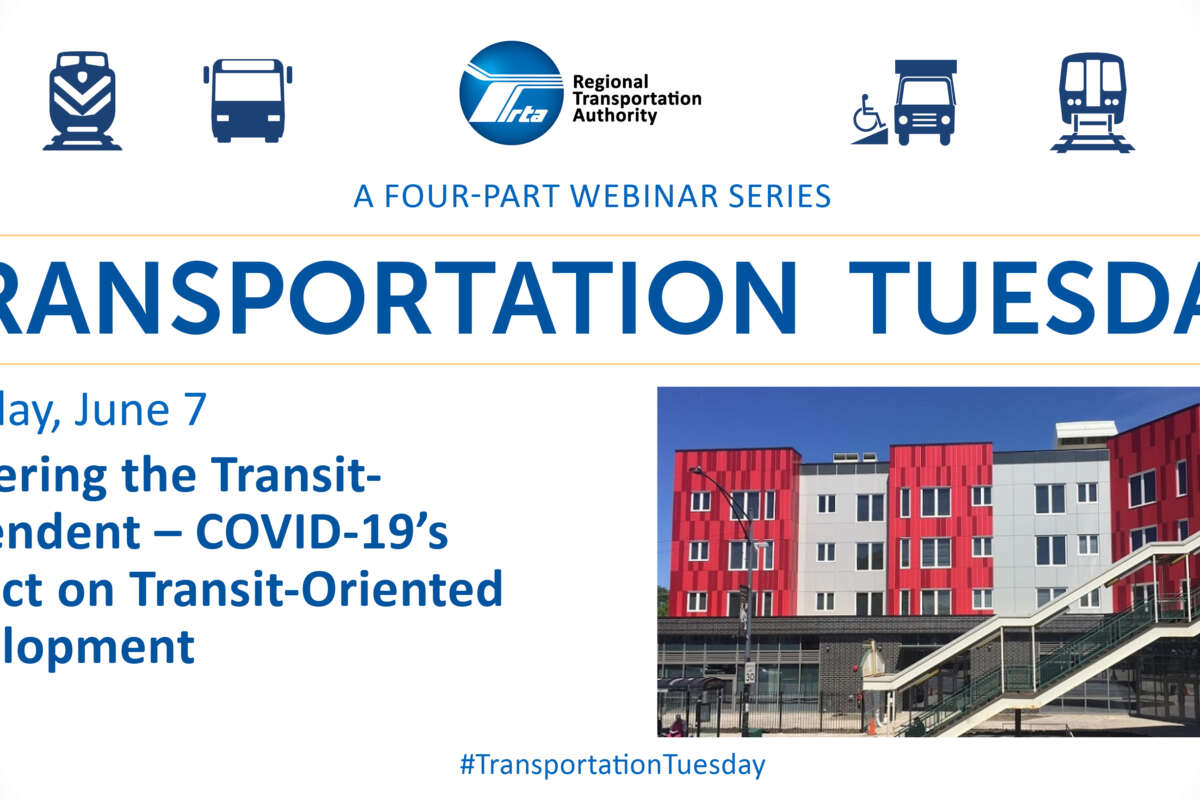
Transit-oriented development (TOD) has successfully brought a mixture of residential, commercial, office, and public uses to transit station areas. How has the sustained decline of public transit ridership brought on by the COVID-19 pandemic changed the way planners, developers, and community groups think about TOD?
In the first webinar of the RTA’s four-part Transportation Tuesday Series, the panel, with representatives from Auburn Gresham, Skokie, Harvey, Highwood, and Preservation of Affordable Housing (POAH), discussed this question and more. Moderated by RTA senior planner Alex Waltz, the panel explored the importance of continued development near transit through an equity lens.
The conversation kicked off with an RTA data overview of the impacts of the COVID-19 pandemic on ridership in the region. The findings from the data revealed that while there was a steady decrease in transit riders, these patterns were not uniform across modes of transportation and locations.
“In Chicago, neighborhoods with higher shares of residents of color—such as largely Black and Hispanic residents on the city’s South and West sides—retained far more ridership at their 'L' stations than those in communities where white families predominate,” Waltz said.
The panel’s discussion centered around four topics: the community’s preferences for transit and land use, community engagement in TOD projects, the equitable distribution of TOD benefits, and investment interest and gentrification.
How have you changed the way you approach transit-oriented development since the COVID-19 pandemic began?
Carlos Nelson, CEO of the Greater Auburn Gresham Development Corporation, explained that prioritization has shifted to educating the residents on TOD. Nelson noted that while public transportation acts as a “great equalizer,” the successful integration of TOD in the neighborhood is dependent on addressing safe, comfortable access to transit.
For the city of Harvey, Director of Economic Development Nicholas Greifer noted that since the pandemic, efforts are being redirected to heavily focus on TOD. The city recently adopted a new TOD plan, developed with the RTA’s Community Planning department, that focuses on investment in the city’s transit infrastructure, improved connections for riders, and transformed public spaces.
Among the panelists, there was a strong consensus that while transit ridership has declined, TOD is a critical tool necessary for economic recovery and to address issues such as residential proximity to schools, restaurants, shops, and other amenities.
How do you describe TOD projects? What are residential concerns about new TOD projects?
Across the board, the panelists agreed that community engagement is critical to having a successful TOD project. Molly Ekerdt, Vice President of POAH Chicago, said they conduct a survey before starting a development project and participate in robust community engagement throughout the process. Nelson said residents on the South Side are concerned about the trustworthiness of developers because of the disinvestment they’ve experienced. To build trust, the City, planning agencies, and developers need to not only include the community, but see community members as leaders on these projects.
Panelists said that gentrification and displacement are often major resident concerns around TOD projects.
“The ‘G word,’ as we would call it, that conversation is held quite a bit,” Nelson said. “We certainly feel that when the redevelopment is done from inside out—by local developers, local [community development corporations], not-for-profits—that community ownership model is the way to stem the tide.”
Which types of developments do residents seem most interested in?
Scott Coren, City Manager of Highwood, said it’s important to strike a balance with TODs between what type of development is popular and what type of development is needed by the community. For example, small-scale retail is popular among residents, but the reality is that brick-and-mortar retailers struggle to be successful.
Carrie Haberstich, AICP, Planning Supervisor for the Village of Skokie, said residents aren’t necessarily concerned about or opposed to density, but there is often concern over building height. Getting the community on board with tall, dense buildings requires effective engagement.
Nelson said through the Greater Auburn Gresham Development Corporation quality of life planning process, residents expressed a desire for more healthy living resources, access to healthy food, and financial stability. A Healthy Lifestyle Hub will open in the neighborhood in July and will meet many of these needs.
While it seemed possible that the sustained decrease in transit ridership due to the COVID-19 pandemic would render TOD irrelevant, in reality TOD is still highly desired from an equity and economic development perspective. And although ridership declined across the region’s transit services, it declined less in communities of color, indicating that centering the transit-dependent in TOD is more important than ever—and that there is interest among planners, economic development experts, and community advocates to do just that.
Transportation Tuesday takes place every Tuesday in June. The webinar is free, but registration is required. Learn more about future events, and register to attend here.
Subscribe to our Newsletter
Related Articles
 Northern Illinois Transit Authority Begins New Era for Regional Transit
New regional transit authority unifies CTA, Metra and Pace around shared vision for safer, more reliable and better-connected transitThe Northern Illinois Tr...
September 1, 2026 Study lays groundwork for more coordinated regional transit service under NITA
A new regional transit service coordination study will help bridge between current service planning practices and the first Northern Illinois Transit Authori...
August 3, 2026 RTA announces largest Access to Transit program, bringing $11 million of bicycle and pedestrian improvements to stations throughout region
The RTA has selected 21 new projects at a total cost of $10.9 million for its Access to Transit program, making it the largest round of funding in agency his...
June 24, 2026 Recently completed Community Planning projects to improve mobility in Bronzeville, Sauk Village
This spring, two projects wrapped up that will make communities throughout the Chicago region more equitable, accessible, and transit-friendly, thanks to sup...
June 11, 2026 How the NITA trailer bill and 2027 state budget will impact Chicagoland transit
On May 31, 2026, the eve of the Northern Illinois Transit Authority (NITA) Act (Public Act 104-457) taking effect, the Illinois General Assembly passed trail...
June 11, 2026 RTA adopts Human Services Transportation Plan (HSTP) to improve transportation access for all
At their May meeting, the RTA Board of Directors adopted the 2026 Human Services Transportation Plan (HSTP), a federally required document that identifies tr...
June 1, 2026